
AGS Card Grading Glossary
Explore the definitions of terms used in AI card grading, condition analysis and AGS grading report.
Grading Terms
AI Grading
Automated grading using machine learning, computer vision, and measured data instead of human opinion.
Automated Grading
A grading process performed entirely by machines and AI.
Robograding
The AGS system where machines grade cards without human involvement.
Centering
The alignment of the card’s design inside the card borders, measured mathematically.
Edges
The four sides of a card where chipping, whitening, or fraying occurs.
Corners
The four corner points of a card; evaluated for sharpness, bends, and softening.
Surface
The front and back layers of a card, inspected for scratches, dents, lines, or gloss issues.
Subgrades
Individual scores for centering, corners, edges, and surface.
Final Grade
The combined score from all measured grading categories.
Gem Mint
A card with near-perfect condition across all categories.
Mint
A high-grade card with small but noticeable minor flaws.
Near Mint
A card with moderate flaws but overall good condition.
Population Report
A database showing how many cards exist at each grade level.
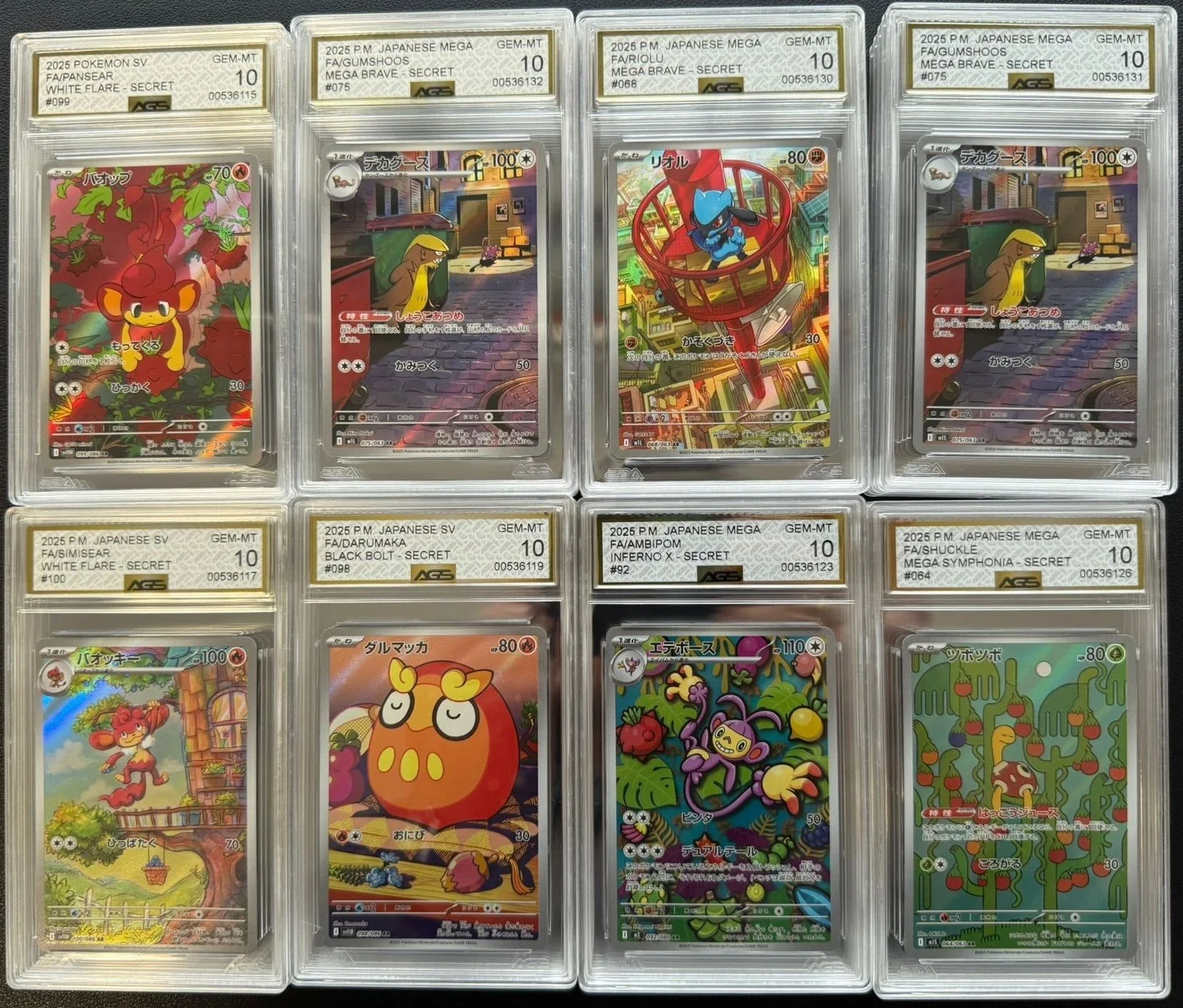
Slab
A sealed plastic case that protects and certifies a graded card.
Cert Number
A unique identification code assigned to every AGS-graded card.
Heatmap
A visual tool that highlights detected flaws on the card.
Scan Report
The full diagnostic report showing all measurements, defects, and images.
Digital Fingerprint
A unique scan record tied to each graded card.
Transparency Report
A document showing exactly how and why a grade was assigned.
AI Detection
The process where AI identifies defects using pattern recognition.
Defect & Damage Terms
Whitening
White areas on edges caused by ink chipping or fiber exposure.
Chipping
Small pieces of ink or foil missing from edges.
Micro-Scratches
Tiny scratches visible under strong light or magnification.
Print Line
A thin straight line caused by manufacturing rollers.
Roller Mark
A printing defect created during production by roller movement.
Dent
A small indentation caused by pressure or impact.
Impression
A mark left from stacking or pressing objects on top of the card.
Foil Scratch
A scratch on holo or foil areas.
Holo Wear
Scratches or dullness on holographic surfaces.
Textured Surface
Raised printing texture found on modern Pokémon or high-end cards.
Gloss Degradation
Loss of shine on the surface due to wear or cleaning.
Edge Fraying
Loose paper fibers on the card edges.
Corner Softening
Rounded or softened corners from handling or age.
Corner Bend
A visible crease or fold in a corner.
Indent
A deeper press mark that alters the card’s surface level.
Foil Lift
The foil layer peeling away from the card.
Print Dot (Snow)
Small white dots caused during the printing process.
Ink Smudge
Unintended ink transfer or printing error.
Misprint
Incorrect text, colors, or alignment from the factory.
Surface Break
A break or chip in the card’s coating or printed layer.
AI & Technology Terms
Computer Vision
Technology that allows machines to understand and analyze card images.
Machine Learning
Algorithms that improve accuracy by learning from large datasets.
Neural Network
AI model that recognizes flaws and patterns in images.
Depth Scanning
Laser scanning that measures surface height and texture.
Reflective Mapping
AI analysis of how light reflects off the surface to detect defects.
Texture Analysis
AI evaluation of surface patterns for abnormalities.
Pixel Segmentation
AI separates card regions for precise defect detection.
Boundary Detection
AI identifies the borders of the card for centering measurement.
Feature Extraction
AI identifies key elements like corners, edges, and textures.
Defect Classification
AI categorizes flaws based on type and severity.
Scanning Resolution
The clarity level of card images used for grading.
Micro-Measurement
AI’s ability to measure defects at extremely small scales.
Reflective Noise Filtering
AI filtering out glare to detect true defects.
AI Weighting Model
How AI determines the importance of each defect.
Algorithmic Consistency
AI’s ability to produce the same result repeatedly.
Model Update
An improvement made to AGS’s AI grading system.
Calibration
The process of ensuring AI accuracy with reference standards.
Automated Handling
Robotic card handling without human contact.
Pattern Recognition
AI identifying repetitive manufacturing patterns.
Anomaly Detection
AI spotting deviations from normal card structure.
Printing, Manufacturing & Material Terms
Card Stock
The paper material a card is printed on.
Foil Layer
A metallic layer used in holo or premium cards.
Coating Layer
A protective finish applied to the card’s surface.
Print Alignment
How well the card’s artwork is positioned.
Border Thickness
The width of the card’s printed border.
Cut Angle
The angle at which the card was cut from the sheet.
Sheet Cutting
The factory process that shapes cards.
Off-Center Cut
A misalignment caused during cutting.
Factory Warp
Bending that happens during manufacturing/packaging.
Surface Texture Pattern
The intended visual texture of a card.
Chroming
A reflective printing process used in sports cards.
Rainbow Foil
A holographic foil coating used in special cards.
Embossed Texture
Raised printing found on some premium issues.
Matte Surface
A non-reflective card surface.
Gloss Surface
A shiny surface prone to scratches.
Print Registration
Alignment of the different printing layers.
Print Shift
A misalignment between color or texture layers.
Error Card
A card with factory-level printing or cutting errors.
Scrap Line
A faint factory line from excess cutting material.
Card Warp
Curving caused by temperature or humidity.
Collector, Market & AGS Terms
Raw Card
A card that has not been graded or slabbed.
Slabbed Card
A card sealed in a grading case.
Pre-Grade Inspection
Reviewing a card before sending it to grading.
Pre-Screening
Submitting cards only if they meet a chosen grade threshold.
Submission Form
The paperwork required to send cards in for grading.
Bulk Submission
Sending many cards at once for discounted grading rates.
Premium Submission
A faster or special grading service tier.
Market Value
The current selling price of a card.
Estimated Grade
A collector’s guess before grading.
ROI (Return on Investment)
Profit made from grading and reselling a card.
Low-Pop Card
A card with a small population in high grades.
High-Pop Card
A common card with many graded copies.
Risk Factor
How likely a card is to grade poorly.
Grading Candidate
A card considered likely to grade well.
Reholder
Replacing an old or damaged slab.
Regrade
Submitting a card again for a new grade.
Crossover
Moving a card from one grading company’s slab to another.
Cert Lookup
Searching for a card’s grade information online.
Transparency Grading
A grading approach where data and flaws are fully shown.
AI-Verified Condition
A card whose condition is confirmed by AI measurement instead of human judgment.